
October 9, 2026
The Social Side of Disability: Why Belonging Matters as Much as Access
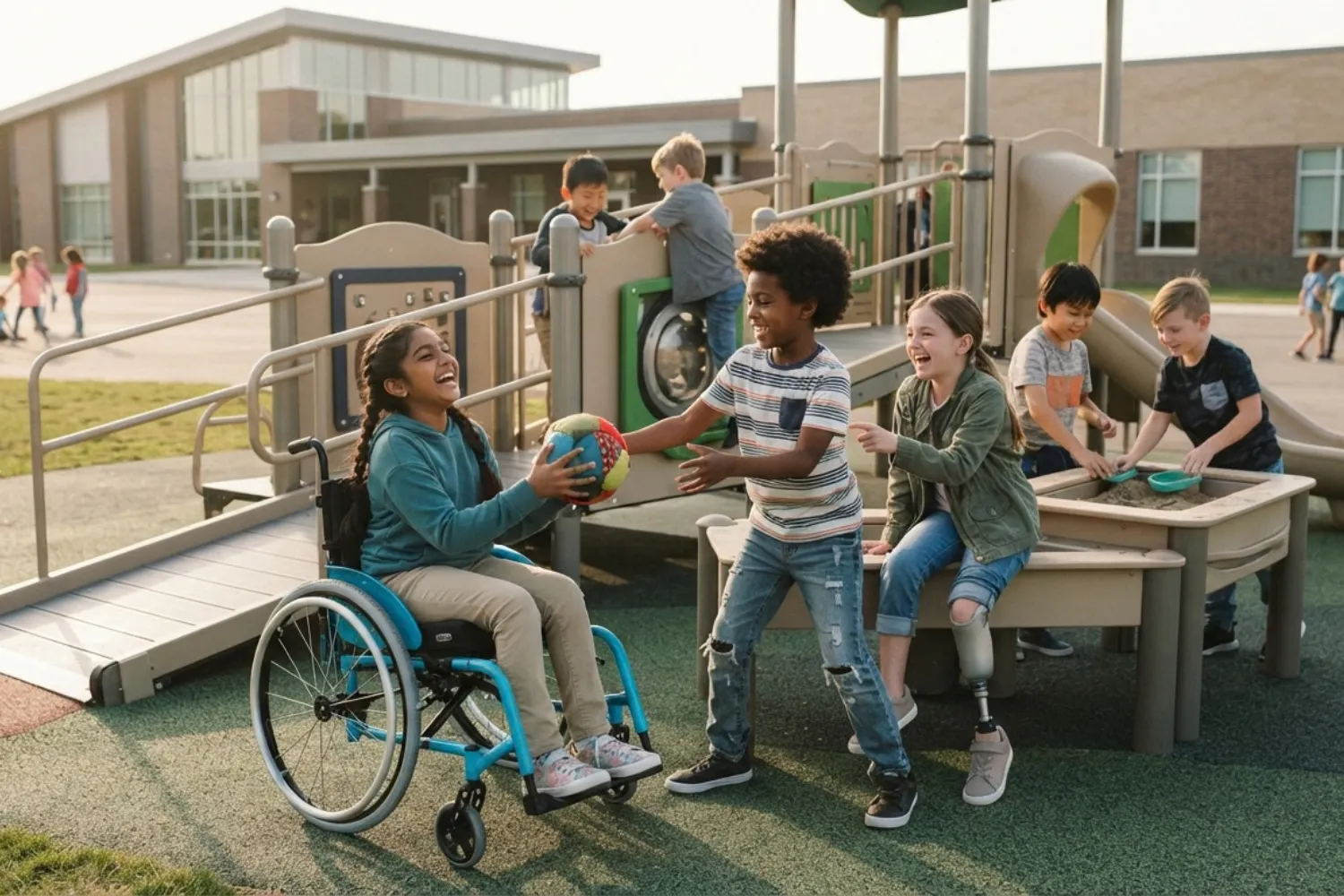
Access is the door. Belonging is the room.
Most conversations about disability inclusion begin, and often end, with access. Is there a ramp? Is the programme free? Is there an interpreter? Can the child get on the bus? These questions matter enormously, and the fight to answer "yes" to them has taken decades.
But anyone who has spent time with children and families knows that getting through the door is only the first step. A child can be enrolled in a school, registered in a youth club, seated in a classroom and technically "included" while spending every break alone, never being invited to a birthday party, and going home each day with the quiet understanding that they are present but not part of anything.
This is the social side of disability, and it is where much of the real work of inclusion now lies.
What the numbers tell us
The scale of the issue is large. UNICEF's Seen, Counted, Included report (2021) estimated that nearly 240 million children worldwide live with a disability, roughly one in ten. The WHO's 2022 Global Report on Health Equity for Persons with Disabilities estimates that around 1.3 billion people, about one in six of the world's population, experience significant disability.
Access to education remains uneven. UNICEF's analysis found that children with disabilities are around 49 percent more likely to have never attended school, and are also more likely to be out of primary and lower secondary school than their peers without disabilities. In many countries, simply getting a child into a classroom is still a victory.
Yet for the children who do get there, the social picture is often troubling. Research across many countries and settings consistently finds that children with disabilities are more likely to be bullied, left out of peer groups, and described as lonely than their classmates. Depending on the study, population, and type of impairment, estimates of bullying risk range from about two to three times higher than for non-disabled peers. Children with intellectual disabilities, autism and communication differences are frequently among the most affected, and the pattern appears in mainstream settings and special settings alike.
In other words: placing a child in the same room as other children does not, by itself, create friendship.
Why friendship is not a "nice extra"
It is tempting to treat social life as secondary to "real" needs such as therapy, learning goals and medical care. The evidence suggests the opposite.
- Friendship shapes development. Peer relationships are where children practise negotiation, humour, empathy, turn-taking and conflict repair. These are skills no worksheet can fully teach.
- Belonging protects mental health. Decades of research link a sense of belonging at school and in the community with lower rates of anxiety and depression, and loneliness is now recognised by the WHO as a significant public health concern across the lifespan.
- Social networks open doors. Many adults get their first job, flat, hobby or opportunity through someone they know. Young people with disabilities who have thin social networks lose access to this informal channel, one reason employment gaps persist.
- Belonging builds identity. A child who is invited, missed when absent, and expected to show up learns something important: I matter to other people.
Families know this instinctively. Ask parents of a child with a disability what they most worry about, and many will not say "grades" or "therapy." They will say: Will my child have friends? Who will invite them? Who will be there when I'm not?
The hidden barriers that ramps cannot fix
If physical and logistical access were all that stood between children and belonging, inclusion would be a matter of budgets and building codes. The social barriers are subtler.
1. The invitation gap. Many children with disabilities attend the programme but are never invited to what happens around it: the birthday party, the sleepover, the group chat, the after-school football game. Sometimes this is thoughtlessness. Sometimes parents of other children are unsure what to do ("What if she needs help? What if something goes wrong?") and quietly avoid the question.
2. The "helper" trap. Children with disabilities are often cast in the role of the one who is helped, while classmates become helpers. Kindness is good, but a relationship in which one person is always the recipient is not a friendship. It is a care arrangement. Real friendship is reciprocal: shared jokes, shared interests, equal footing.
3. Adults who hover. Support staff and aides are often essential. But an adult sitting beside a child at every moment can unintentionally act as a barrier, since other children may talk to the adult rather than the child, and the child never gets unsupervised social practice. Good support knows when to step back.
4. Communication differences read as disinterest. A child who uses an AAC device, signs, communicates slowly, avoids eye contact or speaks in unusual ways may be misread as unfriendly, rude or uninterested. Peers do not always know how to wait, listen or adjust.
5. Activities designed around a single way of participating. Fast-moving games, noisy group work and unstructured free time can be exhausting or confusing for some children. If the only way to join is to join in one specific way, some children are structurally excluded even when "welcome."
6. Low expectations. When adults assume a child "doesn't really mind" being alone, or "prefers their own company," they stop trying. Some children do value solitude, but many are simply waiting for someone to make the first move.
What genuine belonging looks like
Belonging is not a feeling you can mandate, but organisations can create the conditions for it. Programmes that do this well tend to share several features.
Shared goals, not just shared spaces. Research on peer relationships has long shown that cooperation toward a common goal (building something, staging a performance, running a garden) builds bonds better than simply putting children together. Activities with clear roles let every child contribute something real.
Structured opportunities for connection. Not all children can "just go and play." Buddy systems, interest-based clubs, circle-time routines, and peer-mentoring models give children a reason and a framework to interact. The aim is not forced friendship but increased opportunity.
Teaching all children, not just the disabled child. The most effective inclusion approaches do not ask one child to adapt to everyone else. They help the whole group understand difference: how people communicate, why someone might need a break, what to do if a friend uses a different way of talking. Children are generally open and curious when adults model respect.
Valuing strengths. A child with Down syndrome who is brilliant at making people laugh, a child with cerebral palsy who knows every footballer's statistics, an autistic child with encyclopedic knowledge of trains: these are social currencies. Programmes that spot and celebrate them give children something to bring to a friendship.
Involving families and communities. Parents are often the invisible organisers of a child's social life. Organisations can help by hosting family events, connecting parents to one another and giving other families guidance on how to welcome a child with a disability, whether for a party or a playdate.
Listening to the child. Ask: Who do you like spending time with? What would you like to do? What would make this easier? Even children with limited speech can express preferences through pictures, choices, gestures and behaviour.
Questions every organisation should ask
Instead of asking only "Is our programme accessible?", try asking these:
- Do children with disabilities attend and take part in the whole experience, including breaks, trips and celebrations?
- Are they invited to things outside the programme?
- Do they have at least one peer who knows them and misses them when they are absent?
- Do they get a chance to lead, choose and contribute, or are they always supported?
- Do other children understand and respect difference, and are bullying and exclusion actively addressed?
- Would the child say they belong here? Have we asked?
If the honest answer to several of these is "we don't know," that is the starting point.
Practical steps for families
- Start small. One-to-one playdates around a shared interest are often easier than large groups.
- Be the host. Inviting classmates over, on your terms and in a setting that works for your child, is often the quickest route to friendship.
- Prepare other families. A friendly note explaining how your child communicates, what they love, and what helps can ease other parents' anxiety.
- Look beyond school. Faith groups, sports teams, arts classes, scouts and neighbourhood clubs can all provide a fresh social start.
- Notice who your child lights up around. Follow that thread.
Help Create More Spaces Where Every Child Belongs
Every child deserves more than access; they deserve friendship, connection, and the chance to feel like they truly belong. Your donation can help create opportunities, resources, and supportive communities where children with disabilities are welcomed, included, and valued.
Your support can help turn inclusion from simply being present into truly belonging. Donate today and help make a difference in the life of a child.